
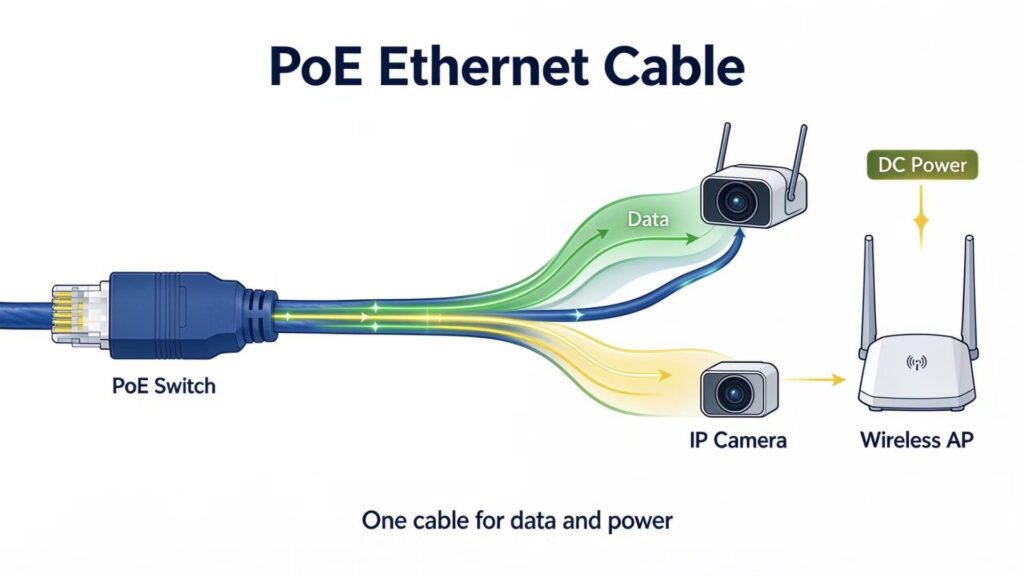
When selecting the right ethernet cable for PoE application, many installers and buyers underestimate how PoE changes cable requirements. Power over Ethernet (PoE) simplifies network deployment by transmitting data and DC power over one single ethernet cable. For IP cameras, wireless access points, VoIP phones and industrial sensors, PoE cuts extra power cords and adapters, which is why it is widely adopted in commercial, security and factory networking projects.
However, a cable that works fine for data transfer may fail to deliver stable PoE power. Voltage drop, heat accumulation and conductor resistance become critical risk factors, especially for high-power PoE++ devices. Choosing the wrong cable leads to intermittent rebooting, insufficient power supply, overheating, and even permanent damage to powered devices.
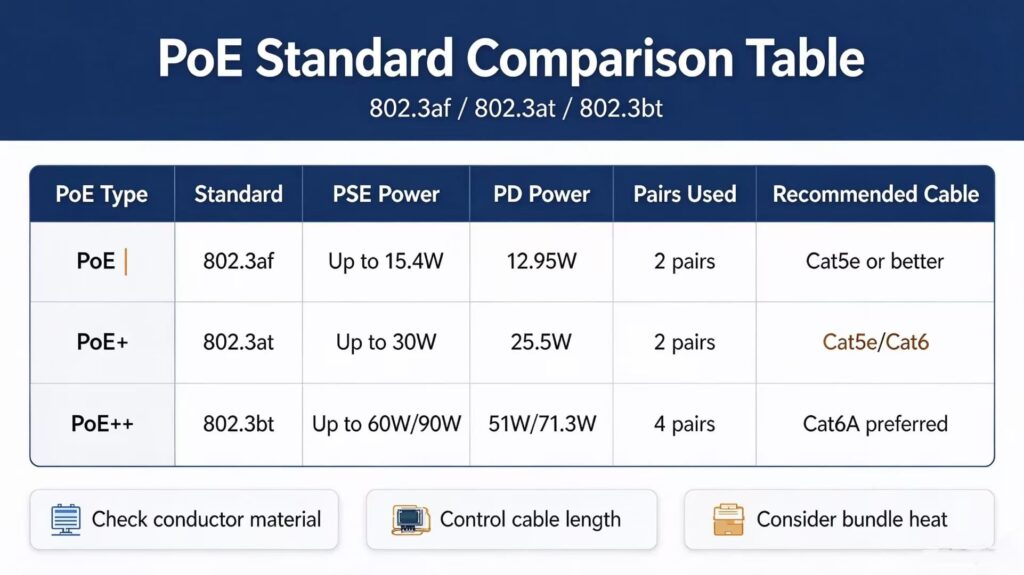
Before specifying your cable, it is necessary to clarify which PoE standard your project adopts: 802.3af (PoE), 802.3at (PoE+) or 802.3bt (PoE++). Each standard defines different power budgets and puts different stress on copper conductors.
IEEE PoE Standard Overview
The IEEE 802.3 series defines three mainstream PoE specifications, differing in available power for end devices:
- 802.3af (PoE / Type 1): PSE supplies up to 15.4W, PD receives 12.95W, power transmitted over 2 conductor pairs. Common for low-power IP cameras and VoIP phones.
- 802.3at (PoE+ / Type 2): PSE supplies up to 30W, PD receives 25.5W, still using 2 pairs. Suitable for high-performance Wi-Fi 6/6E access points and multi-lens cameras.
- 802.3bt (PoE++ / Type3 & Type4): Type3 up to 60W, Type4 up to 90W, utilizing all 4 copper pairs for power delivery. This standard applies to PTZ cameras, industrial displays, small IoT controllers and high-power remote sensors.
It is a common misunderstanding that all Cat5e cables automatically support all PoE modes. The category rating mainly guarantees data bandwidth, while PoE reliability depends more on conductor material, AWG gauge and DC resistance.You can review the official IEEE 802.3 PoE specification overview to check the official power limits for each PoE type.
Core Requirement 1: Conductor Material — Pure Solid Copper Is Mandatory
Conductor material is the top priority for PoE stability. Bare solid copper is the recommended conductor for permanent PoE cabling. You can read our comparison of bare copper and CCA ethernet cable to learn the huge performance gap.
CCA (Copper Clad Aluminum) cable is the most frequent mistake in PoE projects. Aluminum has far higher DC resistance than copper. Under PoE current, CCA creates severe voltage drop and excess heat. It may work for low-speed data transmission, but it cannot sustain stable power delivery, especially for long runs or PoE++ loads. Even if the cable shows link-up at first, heat will build up gradually and trigger device restart or insulation aging.
Stranded multi-conductor cable is acceptable for short patch cords only. For fixed backbone cabling running dozens of meters, solid copper is always preferred, with lower resistance and better heat dissipation. You can check the difference between solid and stranded copper cable for more construction guidance.
Core Requirement 2: AWG Wire Gauge and Voltage Drop for your ethernet cable for PoE application
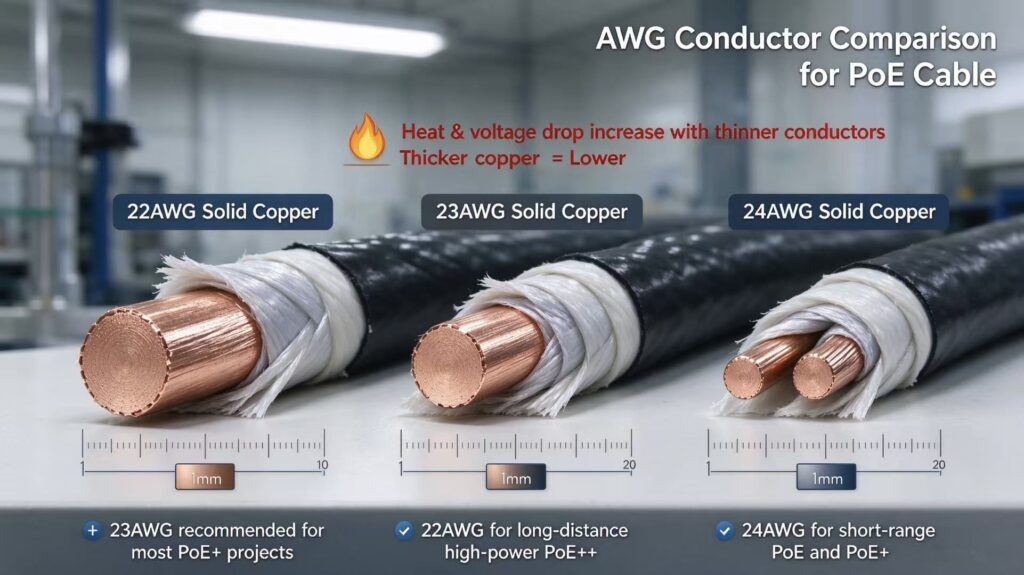
AWG directly decides conductor cross-section and resistance. Thicker wire (smaller AWG number) reduces voltage drop and heat generation.
- 24AWG solid copper: Works well for PoE and PoE+ within 80–90 meters; not ideal for long-distance PoE++
- 23AWG solid copper: Best balanced option for most PoE+, short-run PoE++ and bundled cable installations
- 22AWG solid copper: Reserved for long-distance high-power PoE++ deployments where voltage margin is tight
The famous 100-meter ethernet limit is originally defined for data signal. When carrying PoE power, you cannot simply fill the full 100m length without checking voltage budget. The more power your device draws, the shorter the safe run should be. If you bundle dozens of PoE cables tightly inside conduit, mutual heat accumulation will further shorten the usable distance. This voltage drop and thermal risk for bundled PoE runs is covered in the official CommScope PoE cabling thermal and installation guidance.
Core Requirement 3: Cable Category (Cat5e / Cat6 / Cat6A)
- Cat5e: Minimum acceptable for 802.3af PoE and 802.3at PoE+. It supports gigabit data and 2-pair power delivery. It is widely used for budget-friendly small security systems.
- Cat6: Recommended baseline for new PoE projects. Tighter crosstalk control, better bandwidth and stable performance when bundled together. It handles PoE+ smoothly and supports Type3 PoE++ under proper AWG and length control.
- Cat6A: Mandatory choice for Type4 90W PoE++. It also supports 10Gbps data, making it future-proof for industrial and high-density data room cabling.
Cat7 and Cat8 are rarely selected for regular PoE surveillance or AP projects, as their premium bandwidth is overkill for most PoE devices and raises project cost unnecessarily.
Core Requirement 4: Jacket Material & Environmental Ratings
PoE cables carry current and generate heat, so jacket temperature rating matters more than ordinary data-only ethernet cables.
- Indoor office: Standard PVC jacket works for PoE and PoE+ under good ventilation.
- Public building, data center, elevator or transit projects: Choose LSZH low-smoke zero-halogen sheath. You can review our full guide on PVC, TPE, PUR and LSZH cable jacket material to match jacket types with installation environments.
- Outdoor / direct burial: UV-stabilized PE jacket, water-blocking structure, rated for continuous moisture and sunlight exposure.
Avoid thin, low-grade jacket compounds for high-power PoE. Continuous heat from current will accelerate jacket aging, cracking and insulation failure.
Core Requirement 5: Shielding Selection for PoE
Shielded (FTP/SFTP) PoE cables are not required for every installation. Use shielded construction only if your cable runs alongside high-voltage power lines, near variable-frequency drives or factory automation equipment with strong EMI noise.
One critical reminder: If you deploy shielded PoE cable, follow proper grounding rules. Poor or inconsistent grounding on shielded cable will introduce ground loop noise and cause random PoE disconnection. Unshielded UTP is sufficient for most office and regular camera installations.
Quick Selection Checklist For PoE Cable
- Confirm PoE standard: af / at / bt
- Conductor: Bare solid copper, reject CCA
- AWG: 23AWG preferred for most projects
- Category: Cat5e for basic PoE, Cat6 for general new build, Cat6A for PoE++ 90W
- Jacket: Match indoor / outdoor / plenum fire and smoke requirements
- Estimate run length and cable bundle density to reserve voltage drop margin
FAQ
Q1: Can Cat5e cable support PoE++ 90W?
A1: Normally no. Cat5e only supports 2-pair power delivery by design. 90W PoE++ uses all four pairs and needs Cat6A cable with sufficient conductor cross-section to control heat and voltage drop.
Q2: Can I use CCA ethernet cable for low-power PoE cameras to save cost?
A2: We strongly advise against it. CCA’s higher resistance creates hidden heat risk. Even low-power cameras may suffer random reboot in hot seasons or long cable runs. It is a false economy.
Q3: Is stranded patch cord suitable for permanent PoE wiring?
A3: Stranded cable is designed for frequent plug-unplug and short jumpers. For fixed long-distance PoE runs, solid copper is more stable with lower DC resistance.
Q4: Does PoE cable need special RJ45 connectors?
A4: Standard RJ45 works, but high-quality crimp termination is critical. Bad crimp creates extra contact resistance, which becomes a hot spot under PoE current and triggers power loss.
Q5: Why does my PoE camera reboot only after several hours of running?
A5: This symptom is most often caused by cumulative heat and voltage drop. Check if you are using CCA, too thin AWG, over-length cable or tightly bundled dozens of PoE cables in a closed conduit.
Q6: Does shielded PoE cable deliver more stable power than UTP?
A6: Shielding only blocks electromagnetic interference, it does not improve power transmission itself. Unshielded UTP works perfectly if there is no heavy industrial noise nearby. Wrong grounding of shield will bring new connection issues.