
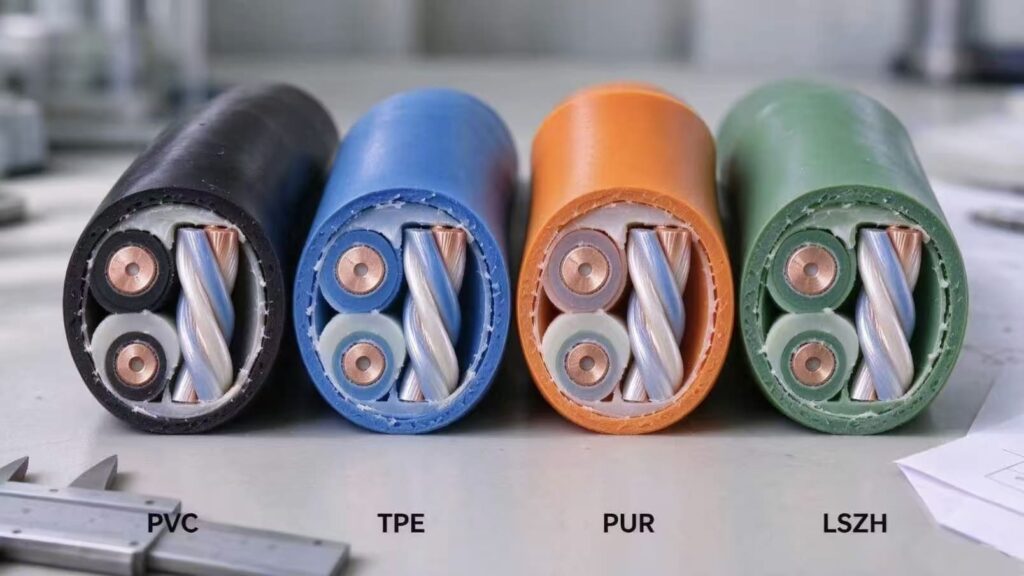
When sourcing industrial and networking cables, many buyers start and stop at the jacket material name. They simply ask “is this PVC? Is it PUR?” and make a purchasing decision based on material labels alone. This selection method often leads to premature cable failure, unexpected downtime or unnecessary overspending on high-grade materials that are overqualified for the working environment.
A good cable jacket is not always the most expensive option. The best outer sheath balances cost and durability, and reliably withstands the temperature, oil, abrasion and repeated bending conditions of its actual installation space. Before locking in a cable jacket material, there are several critical operating parameters you need to clarify first: what temperature range will the cable endure? Will it contact oil, chemical solvents or moisture? How frequent is flexing movement? Are flame retardancy, low smoke and halogen-free properties required for public infrastructure?
What scenarios fit PVC cable outer sheath?
PVC is the most traditional and widely used cable jacket material for general networking and stationary wiring. It has stable basic mechanical performance, affordable cost and decent flame retardant performance for ordinary indoor static installation. That is why most standard Cat5e, Cat6 ethernet patch cords for office wiring adopt PVC outer sheath.
However, PVC has obvious limitations. It will harden and crack under low-temperature conditions, so it is not suitable for outdoor cold environments or continuous flexing applications. Plasticizer migration is another long-term risk. After years of service, the surface may become sticky, brittle or discolored when exposed to heat. You can read Nexans’ technical explanation of PVC plasticizer migration and aging phenomenon for further reference.
PVC jackets fit stationary indoor cabling, fixed cabinet wiring and low-budget general projects. It is not recommended for drag chain moving cables, outdoor buried installation or low-temperature industrial automation scenarios.
When should I choose a TPE cable jacket?
Thermoplastic Elastomer, or TPE, sits between PVC and PUR in performance and price. It delivers better low-temperature resistance and flexibility than PVC, without the high cost of premium PUR grades. TPE jackets remain soft at sub-zero temperatures and resist moderate oil splash, making it a popular middle-ground choice for flexible wiring.
Many flexible patch cords, sensor connection lines and light-duty moving cables use TPE sheath. It is lighter and easier to strip compared with PUR, which brings convenience for on-site termination. Its weakness lies in heavy-duty continuous flexing and long-term immersion in industrial hydraulic oil; it will wear faster than professional PUR material under these harsh conditions. You can check Avient’s official TPE FAQ page to understand the full property spectrum of thermoplastic elastomers.
Why is PUR the preferred sheath for drag chain cables?
PUR (Polyurethane) is the premium choice for high-demand dynamic industrial cabling. It features outstanding abrasion resistance, excellent resistance to mineral oil, lubricants and many industrial chemicals, plus superb repeated flex performance. This is the dominant jacket material for drag chain cables used in robotic arms, automated production lines and continuous reciprocating motion equipment.
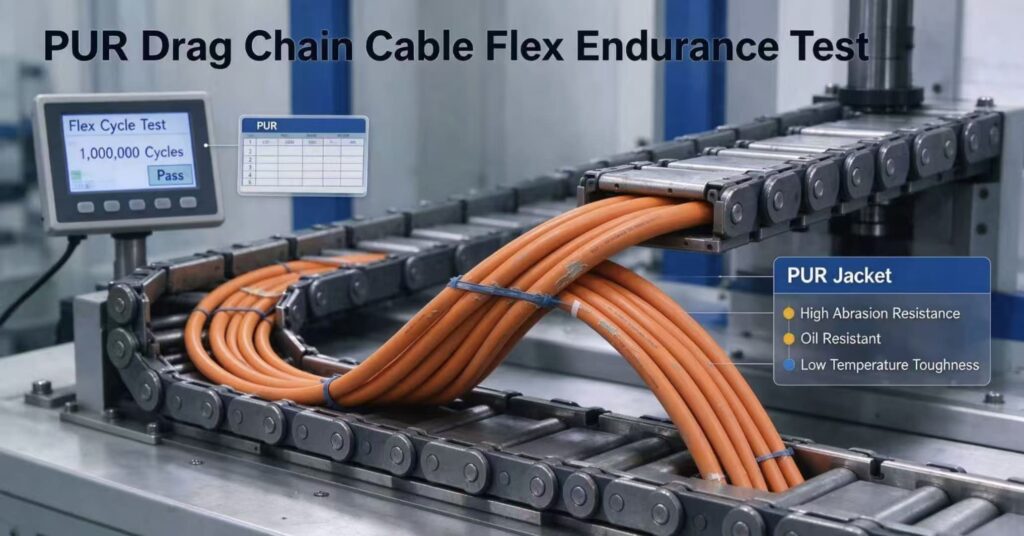
PUR can withstand millions of bending cycles in drag chain systems. It also maintains flexibility at low temperatures, and resists hydrolysis for many outdoor industrial applications. The trade-off is higher material cost. Many customers over-specify PUR for static wiring, which creates unnecessary project cost. SAB Bröckskes provides detailed technical data for PUR cable sheath performance, including temperature range, abrasion and tensile indicators.
PUR is only worth investing in when the cable faces constant movement, friction and oil contamination. Our upgraded stranding production line supports custom cable construction for dynamic industrial applications. Check details about our high-speed twisting machine upgrade project.
What exactly is LSZH cable, and where is it mandatory?
LSZH, Low Smoke Zero Halogen, is not a single polymer material, but a functional classification for cable jackets. LSZH sheath releases minimal smoke and no toxic halogen acid gas during combustion. This property is mandatory for densely occupied public spaces: railway transit, subway systems, shopping malls, data center trunk cabling and elevator wiring.
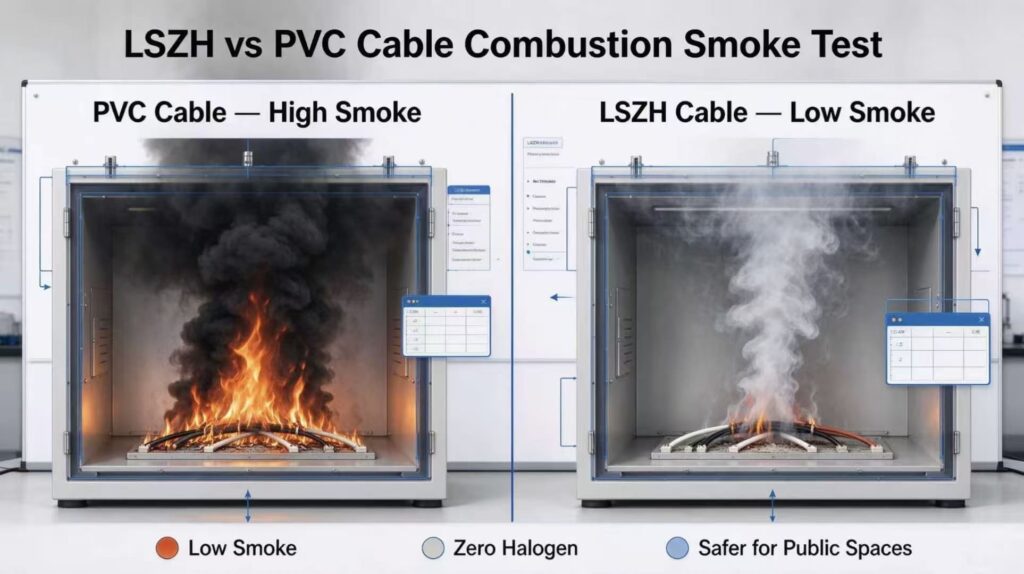
LSZH jackets usually have poorer flexibility and higher hardness than TPE or PUR, and the raw material cost is higher than standard PVC. It is critical to note: LSZH does not equal “fireproof cable”. It focuses on reducing toxic fumes for safe evacuation during a fire. All our custom cables with LSZH requirements go through a full set of lab validation tests before delivery. Our in-house testing lab, equipped with Fluke certification equipment, verifies both electrical performance and sheath material compliance.
Which test standards verify cable jacket real performance?
Material names can be misleading. The real quality of a cable jacket is proven by standardized lab tests. When evaluating supplier samples, you can request test reports against these widely adopted IEC standards:
- IEC 60811-501: Tensile strength and elongation test for insulation and sheath compounds
- IEC 60811-504: Low-temperature bending test, to confirm if the jacket stays flexible in cold environments
- IEC 60332 series: Flame propagation test, verifying vertical flame retardancy
- IEC 60754 series: Test of halogen acid content and corrosivity of combustion gas, core for LSZH qualification
- IEC 61034 series: Smoke density measurement under burning conditions
- UL 1015, UL 3173: North American wire and cable jacket specifications for certified projects
Quick comparison: PVC / TPE / PUR / LSZH cable jacket
| Jacket Material | Core Performance Features | Cost Level | Typical Application Scenarios |
|---|---|---|---|
| PVC | Good basic flame retardancy; rigid at low temperature; risk of plasticizer migration after long-time heat exposure | Low | Static indoor office wiring, cabinet fixed cabling, general low-budget stationary projects |
| TPE | Balanced flexibility; better low-temperature performance than PVC; moderate splash oil resistance, not suitable for long-term oil immersion | Medium | Light-duty flexible wiring, temporary field cords, sensor connection cables |
| PUR | Excellent abrasion resistance, oil & chemical resistance, millions of flex cycles, good low-temperature toughness | High | Drag chain cables, robotic wiring, automation moving cables, outdoor industrial equipment |
| LSZH | Low smoke, zero halogen, low toxic fumes during combustion; relatively stiff, limited flex performance | Medium-High | Subway, railway, shopping mall, data centre backbone, elevator wiring and public infrastructure |
How do I quickly pick the suitable cable sheath?
The core rule stays the same: do not select cable jacket material by name only. Always start from the working environment, temperature, oil exposure, bending cycle and mandatory compliance standards. The right sheath is the one that survives your site conditions at a reasonable cost.
FAQ
Q1: Is LSZH cable fireproof?
A1: No. LSZH means Low Smoke Zero Halogen. It reduces toxic halogen fumes and smoke density when burning, but it cannot stop the cable from catching fire. If you need fire-resistant cables, you need to specify fire-resistance standards separately.
Q2: Can PUR jacket be used for all moving cable applications?
A2: PUR is ideal for high-cycle repeated flexing, drag chain and oil-exposed scenarios. But it is not necessary for simple, occasional bending. TPE will be a more cost-effective choice for light-duty flexible wiring.
Q3: Why does PVC cable turn sticky after years of use?
A3: This is plasticizer migration, a common aging issue of PVC. Heat and long service life accelerate this process. For long-term stable deployment, TPE or LSZH is a better alternative.
Q4: What test reports should I ask suppliers to provide for cable jackets?
A4: Focus on IEC 60811 mechanical tests, IEC 60332 flame test, IEC 60754 halogen test and IEC 61034 smoke density reports according to your project requirements.
Q5: Can TPE replace PUR for drag chain robot cables?
A5: Generally not. TPE cannot withstand millions of continuous bending cycles and long-time oil immersion like PUR. It is only suitable for light, intermittent movement.
Q6: Does a higher-priced cable jacket always mean better quality?
A6: Not really. The best jacket matches your site environment. Using expensive PUR for static indoor wiring is an unnecessary cost waste.