
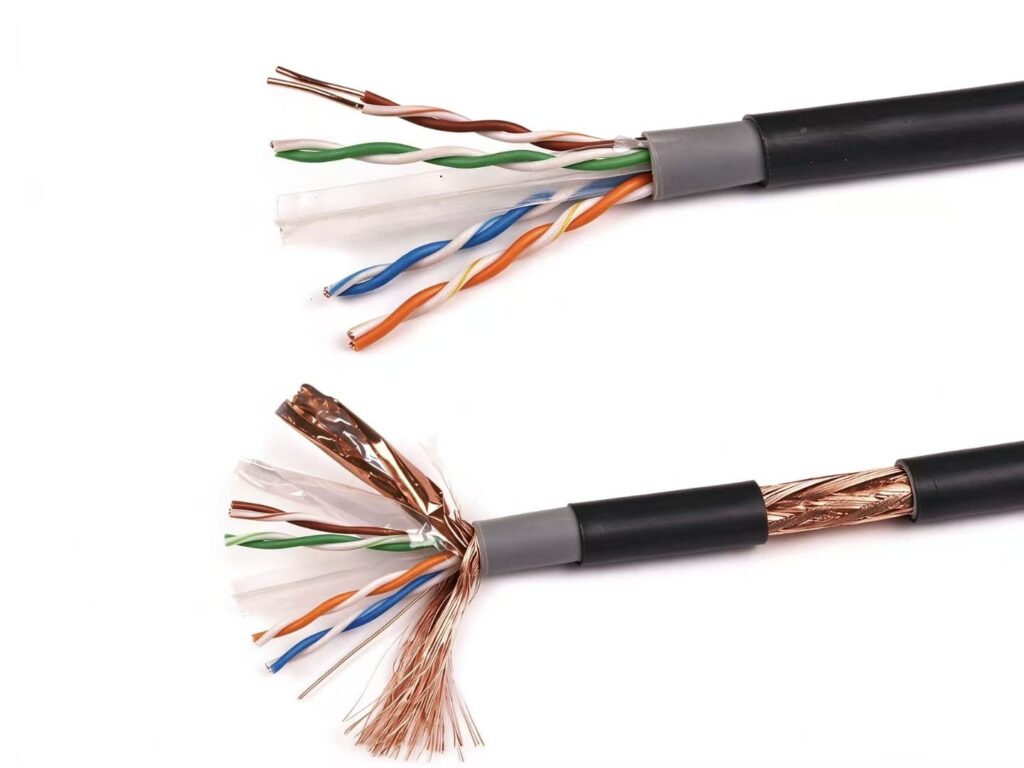
Many network and automation engineers face the same confusing question: when do you really need a shielded network cable? It is easy to assume all industrial networks must use shielded ethernet cable, or that unshielded UTP cable is always enough. The answer depends on your electromagnetic environment, installation conditions and grounding capability. In this guide comparing shielded vs unshielded ethernet cable, we break down how each cable works, common shielding mistakes, and clear rules to decide whether shielding is necessary for your project.
Shielding is not about blocking interference like a solid barrier. It suppresses EMI through three core mechanisms: reflection loss, absorption loss, and multiple reflection correction. At low frequencies, reflection loss dominates; at high frequencies, the skin effect of copper creates strong absorption attenuation. This fundamental principle helps us understand one critical rule: shielding is not a universal upgrade. It solves specific interference problems, and it comes with installation requirements you cannot ignore.
How unshielded ethernet cable (UTP) fights interference
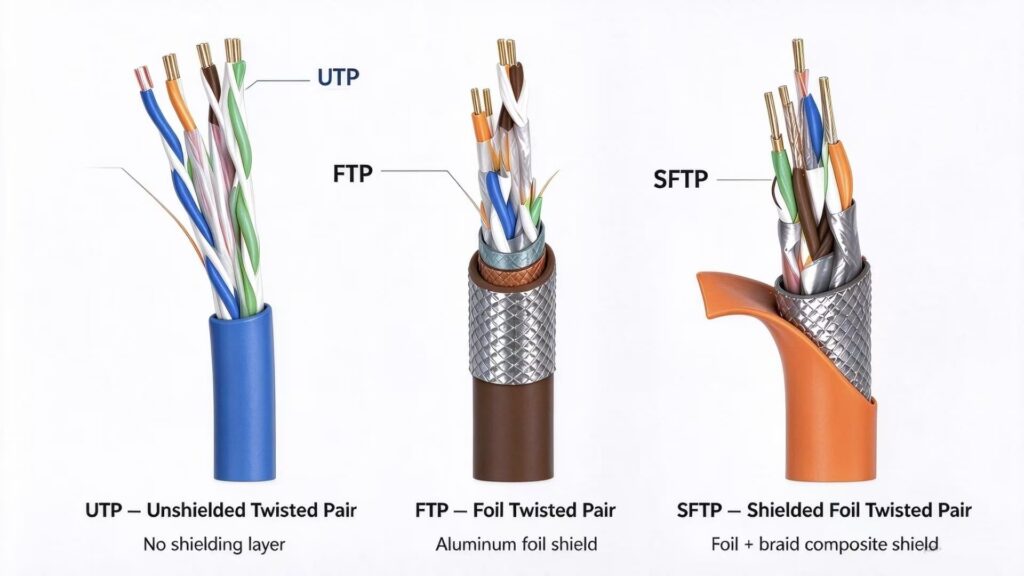
Unshielded ethernet cable has no metal foil or braid layer. Its anti-interference capability fully relies on twisted pair design. When two conductors are twisted tightly, external electromagnetic noise induces nearly identical voltage on both wires. The differential receiving circuit cancels this common-mode noise automatically.
UTP brings clear practical benefits: flexible routing, simple termination, lower material and labour cost. It works reliably when electromagnetic noise is mild. Typical suitable scenarios include office networks, indoor data room cabling, clean workshop areas away from power drives. Our Cat6 unshielded ethernet cable is widely selected for these low-EMI deployment cases.
How different shielded ethernet cable structures work
If you have confirmed that your site needs shielding, the next step is choosing the correct shielding construction. FTP, STP and SFTP each fit different noise conditions.
| Shield type | Structure | Strengths | Limitations |
|---|---|---|---|
| FTP (foil shield) | Aluminium foil wrapped around pairs or whole cable | Full coverage, excellent high-frequency EMI suppression | Thin foil, weak for low-frequency mains noise, easy to crack when bending, must match drain wire for grounding |
| STP (braid shield) | Tinned copper woven mesh | Low DC resistance, stable grounding performance, flexible and resistant to repeated bending | 85–95% coverage, high-frequency signals leak through mesh gaps |
| SFTP (foil + braid composite) | Aluminium foil inner layer + copper braid outer layer | Balanced full-frequency shielding performance | Higher cost, stiffer cable, more complex termination |
A common purchasing trap: judging shielding quality only by braid coverage rate. Coverage standards vary between manufacturers and cannot be used for accurate cross-supplier comparison. The authoritative testing indicator defined by IEC 62153-4-3, the international standard for metallic communication cable shielding measurement, is transfer impedance (Zt, mΩ/m). Lower transfer impedance means better noise suppression effect.
For factory floors near servos and inverters, our industrial SFTP ethernet cable is engineered to meet these demanding EMI requirements.
The biggest precondition for using shielded cable: proper grounding and termination
This rule directly decides whether you should invest in shielded cable. A shielded cable delivers zero advantage if you cannot complete correct grounding and 360° termination.
Aluminium foil cannot be soldered directly. FTP cables must be equipped with a tinned copper drain wire; grounding connects to the drain wire instead of the foil itself. Many installers twist the copper braid into a thin “pigtail” before crimping connectors. This wrong operation introduces extra inductance and destroys high-frequency shielding performance. The standard requirement is 360° circumferential crimping, making the whole shielding layer tightly contact the metal connector shell.
If your construction team lacks experience with shielded cable termination, a shielded cable may perform worse than properly installed UTP. This is a key factor to consider before deciding to buy shielded ethernet cable.
Important limitation: shielding cannot handle low-frequency magnetic fields well
Copper and aluminium are non-magnetic metals. They barely absorb low-frequency magnetic fields such as 50Hz power frequency interference near inverters, transformers and large motors. In these environments, twisted-pair differential cancellation is still the core anti-interference method. Shielding only acts as auxiliary protection. Even SFTP composite shielding cannot completely eliminate low-frequency magnetic interference.
Decision table: When do you need shielded ethernet cable?
This is the core reference table for your site selection. You can judge your requirement quickly against the conditions below.
| Site Condition | Recommended Cable Type | Reason |
|---|---|---|
| Office, clean machine room, far from power equipment | UTP Unshielded | Low EMI, save budget, easy installation |
| Near servo drives, VFD, robot power cabinets, high EMI factory floor | SFTP / FTP Shielded | Strong electromagnetic radiation requires full EMI suppression |
| Short temporary patch cord, low noise environment | UTP Unshielded | No extra shielding benefit |
| Long-distance ethernet runs across power cable trenches | Shielded ethernet cable | Prevent coupled interference along the whole cable route |
| No reliable grounding system or unskilled termination workers | UTP Unshielded | Avoid shielding failure caused by bad installation |
Conclusion
At the end of the day, the decision between shielded and unshielded ethernet cable does not come down to which type is universally superior. It hinges on the actual conditions of your installation site.
Shielded ethernet cable brings its value only when you are working in high-EMI zones near servos, VFDs and power motors, and you have the capacity to implement proper grounding and professional 360° termination. Without these prerequisites, adding shielding offers little benefit and may even create unexpected signal troubles.
For projects located in low-noise spaces such as offices, clean machine rooms or quiet workshop areas, a well-made UTP cable remains a stable, practical and budget-friendly solution.
If you are still sorting out cable specifications for your networking project, understanding EMI environment and installation limits will help you avoid over-specification or inadequate protection. You can also explore our previous article comparing bare copper vs CCA ethernet cable to learn more about conductor material differences that affect long-term cable performance.
FAQ
Q1: Do I have to use shielded ethernet cable for all industrial networks? A: No. Shielded cable is only necessary in high-EMI environments. Clean industrial zones can use reliable unshielded UTP ethernet cable.
Q2: What problems will happen if I install shielded cable without good grounding? A: Poor grounding or wrong termination will make shielding invalid. In some cases, it may even introduce extra noise and perform worse than UTP.
Q3: Which shielded type should I pick for VFD and servo cabinet wiring? A: SFTP composite shielded ethernet cable is the preferred choice for harsh industrial environments with variable-frequency drives and servos.
Q4: Is braid coverage percentage the main standard to select shielded ethernet cable? A: No. Transfer impedance (Zt) tested under IEC 62153-4-3 is a more consistent and professional indicator for shielding performance.
Q5: Can shielded cable block 50Hz low-frequency magnetic interference from inverters? A: Its suppression effect is limited. Twisted pair differential cancellation is the main protection for low-frequency magnetic field noise.
Q6: Is unshielded ethernet cable suitable for factory use? A: Yes. UTP works well in factory areas far from motors and power equipment, as long as there is no severe electromagnetic interference.