
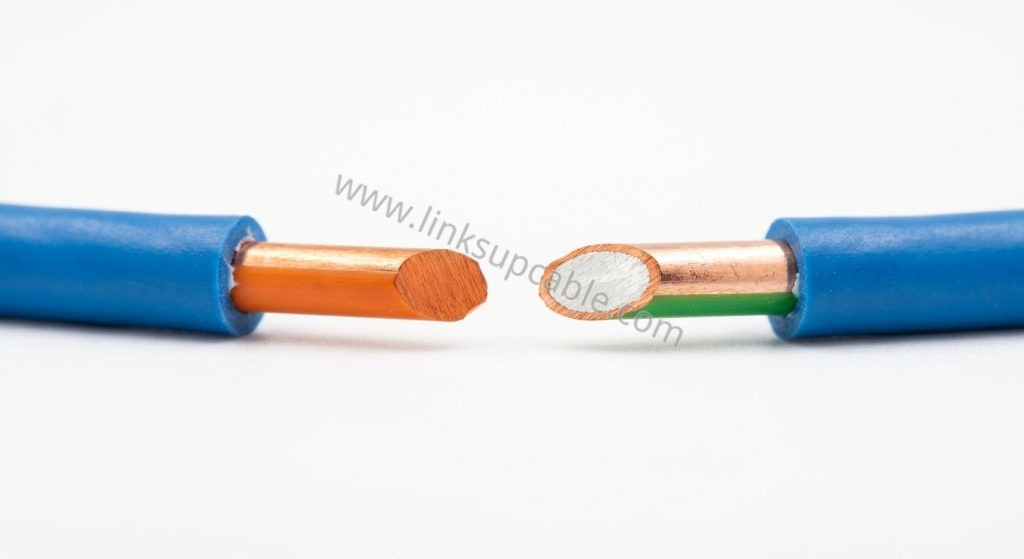
A buyer sent us two quotations last month and asked why ours was 40% higher. Both said “Cat6, 305m, 23AWG, UTP, blue.” On paper they were the same cable. They were not the same cable. The other quotation was copper-clad aluminium, and the difference between those two products only becomes visible eighteen months later, when the access points on the third floor start rebooting.
This article explains what CCA is, why it keeps arriving on job sites despite being unsuitable for most installations, and — most usefully — the three tests you can run yourself to find out what you have actually been shipped.
What Is CCA Cable?
CCA stands for copper-clad aluminium. The conductor is an aluminium core with a thin layer of copper bonded to the outside, typically around 10–15% of the cross-section. It exists because aluminium is far cheaper and much lighter than copper, and because at high frequencies a phenomenon called the skin effect pushes signal current toward the outer surface of a conductor — which is the argument CCA vendors use to claim performance parity.
The argument is not entirely false, and that is what makes CCA dangerous. For pure high-frequency data signalling over a short distance, a CCA conductor can look acceptable on a basic test. The problems appear everywhere else: DC resistance, power delivery, mechanical strength, corrosion behaviour and regulatory compliance.
The Five Real Problems With CCA
1. It Fails Power over Ethernet
This is the decisive issue in modern networks. Aluminium has roughly 61% of the conductivity of copper, so a CCA conductor of the same gauge carries around 55% more DC resistance. Power over Ethernet pushes real current through that resistance, and resistance turns current into heat.
At 802.3af levels on a single cable this may go unnoticed. At 802.3bt, delivering up to 90 watts to a Wi-Fi 7 access point or a PTZ camera, and with forty cables bundled in a tray where none of them can shed heat, the bundle temperature climbs. Higher temperature raises resistance further, which generates more heat — and insertion loss rises with temperature, so the data link degrades at the same time. The symptoms are the worst kind: intermittent device reboots, ports dropping under load, faults that disappear when a technician arrives because the load has dropped while they drove over.
2. It Breaks at the Punch-Down
Aluminium work-hardens. Bend it repeatedly and it becomes brittle rather than staying ductile the way copper does. A CCA conductor punched into an IDC contact, then adjusted, then re-seated, will often fracture inside the insulation where no one can see it. The link may pass a wiremap test on the day and fail three months later when the building settles or someone moves a patch panel. Installers who have been burned by this recognise the pattern immediately.
3. It Corrodes at Every Termination
When aluminium and copper make contact in the presence of moisture, galvanic corrosion begins at the junction. Every punch-down, every crimp, every plug contact on a CCA cable is a bimetallic junction. Aluminium also forms an oxide layer the moment it is exposed to air, and that oxide is an insulator — which is why CCA terminations develop rising contact resistance over time rather than staying stable.
4. It Usually Violates Electrical Code
In the United States, permanent communications cabling must be listed to the relevant NEC articles, and CCA cable generally is not listed for that use. Similar restrictions apply in many other jurisdictions. Installing unlisted cable in a commercial building can fail inspection, void insurance and, in a fire investigation, create liability that dwarfs the cable saving. Any supplier who cannot produce a UL or equivalent listing for the specific product they are quoting should be treated with caution.
5. It Cannot Hold Full-Distance Performance
Higher DC resistance means higher insertion loss, and insertion loss is the budget that determines how far a link can run. A CCA cable that certifies at 40 metres may fail at 90. Since the horizontal run is exactly where installers cannot easily replace cable, this is the worst possible place to discover the problem.
We do not manufacture CCA. Not because we cannot — it would be simple and profitable — but because every CCA order eventually returns as a warranty claim, and the claim always arrives after the installer has already paid for the labour twice.
Three Tests You Can Run Yourself
You do not need a laboratory to identify CCA. These three checks take about ten minutes and settle the question.
Test 1: Weigh the Box
This is the fastest and most reliable check, because copper is roughly three times denser than aluminium and the conductor is most of the cable’s mass. Weigh a full 1000ft (305m) box on any parcel scale.
| Cable type | Genuine bare copper | CCA |
|---|---|---|
| Cat5e 24AWG UTP, 1000ft | approx. 8.5–10 kg | approx. 5.5–6.5 kg |
| Cat6 23AWG UTP, 1000ft | approx. 11–13 kg | approx. 7–8 kg |
| Cat6A 23AWG F/UTP, 1000ft | approx. 15–17 kg | approx. 10–11 kg |
The gap is large enough that you cannot mistake it. If a supplier’s 1000ft Cat6 box arrives at 7 kg, no laboratory test is required. Note that the figures above are cable only — subtract the carton, usually 0.5–0.8 kg.
Test 2: Scratch the Conductor
Strip a single conductor and scrape the surface firmly with a knife blade or wire stripper, or snip it at an angle and look at the cut face under good light. Solid bare copper is the same warm copper colour all the way through. CCA reveals a bright silver-white aluminium core beneath a thin copper skin, exactly as shown in the photograph at the top of this article. This is the test to run when you receive a sample, before you place a volume order.
Test 3: Measure Loop Resistance
For a definitive number, measure the DC loop resistance of a known length with a multimeter: short two conductors of a pair at one end and measure across them at the other. A 100 metre loop of 23AWG solid bare copper reads roughly 18–19 ohms at room temperature. CCA of the same gauge will read around 28–30 ohms. Any certifying tester that reports DC resistance unbalance will also flag CCA immediately, which is why CCA cable so often fails a proper channel certification even when it passes a cheap continuity tester.
How CCA Reaches Job Sites
Understanding the supply chain helps you avoid it. CCA rarely arrives labelled as CCA. The common patterns are:
- Ambiguous specifications. A datasheet says “copper conductor” without saying bare copper, or says “high-purity conductor,” which is meaningless.
- Certification borrowed from another product. A supplier shows a UL certificate for their bare copper line while quoting a CCA line. Always check that the certificate references the exact part number being quoted.
- Mid-order substitution. The sample is genuine copper and the production run is not. This is why we weigh and burn-test every batch and issue per-batch data rather than a single sample report.
- The buyer specified on price alone. Most often, nobody intended to buy CCA. A purchasing department compared three lines on a spreadsheet and took the cheapest matching description.
Is CCA Ever Acceptable?
We try not to be dogmatic about this. There are narrow cases where CCA is defensible: short temporary patch leads with no PoE, extremely price-sensitive consumer retail packs where the cable will never be permanently installed, or non-critical low-speed links. If you are building a promotional bundle of 1-metre cords for a retail promotion and nothing will draw power through them, CCA is not a scandal.
What CCA should never be used for is permanent horizontal cabling, any run carrying PoE, any installation subject to electrical inspection, or anything a customer expects to last a decade. That covers essentially every structured cabling project. For those applications we build our Cat6 and Cat6A bulk cable exclusively in 100% oxygen-free bare copper, and we verify it on every batch by reel weight against calculated copper mass, loop resistance measurement, and a destructive burn-and-inspect sample.
What to Write Into Your Purchase Order
Specification language is your best protection. Vague wording is what lets substitution happen. We recommend requiring all five of the following in writing:
- “100% bare copper conductor, CCA and CCS not accepted.” Name the exclusion explicitly rather than implying it.
- Conductor gauge and construction. For example 23AWG solid for bulk cable, 28AWG stranded for slim patch cords.
- Certification referencing the exact part number, not the supplier’s catalogue generally.
- Per-batch test data, not a one-off sample report from a previous production run.
- A stated shipping weight per box, which gives you a contractual basis to reject a substituted shipment on arrival.
That fifth point is more powerful than it looks. A supplier willing to put box weight in writing is telling you what is inside it. A supplier who refuses has answered your question.
Frequently Asked Questions
Does CCA work at all? Yes — it will pass data, which is precisely the problem. It works well enough to pass a basic test and be installed, then fails later under PoE load, at distance, or mechanically at terminations.
Is CCA cheaper enough to be worth the risk? CCA typically runs 30–45% below bare copper. Against that, weigh the cost of re-pulling horizontal cable in a finished building, which is several times the original cable cost, plus the labour already spent.
How do I know my current installation is copper? Look at the jacket print — most compliant cable prints the conductor type — then snip a spare tail and check the cut face. If there is no spare tail, weigh any unopened box left over from the job.
Is CCS the same as CCA? CCS is copper-clad steel, most common in coaxial cable. It shares the same DC resistance and termination problems and should be excluded from network cable specifications for the same reasons.
Do shielded cables have the same issue? Yes. Shielding and conductor material are independent. A shielded CCA cable still fails PoE heat rise; the foil does nothing for DC resistance.
What about stranded patch cords? The same rule applies. Our Cat6 patch cords and Cat6A slim flat cables use stranded bare copper. Slim 28AWG cords are particularly sensitive to conductor quality because there is less copper to begin with.
Ask Your Supplier These Three Questions
If you take nothing else from this article, take these. Any competent manufacturer can answer all three in one email:
- What is the conductor material and gauge, stated as “bare copper” in writing?
- What is the nett weight of one 1000ft box of this exact product?
- Can you supply per-batch Fluke test data and a certification document referencing this part number?
We answer those questions on every enquiry, and you can see the equipment behind the third one on our testing laboratory page. If you are comparing quotations right now and one of them is unexplainably cheap, weigh the sample box before you sign. For a full comparison of cable categories, our Cat6 vs Cat6A vs Cat7 vs Cat8 guide covers which specification to choose once you have settled the conductor question, and our OEM and ODM services page explains how we handle private-label production.