
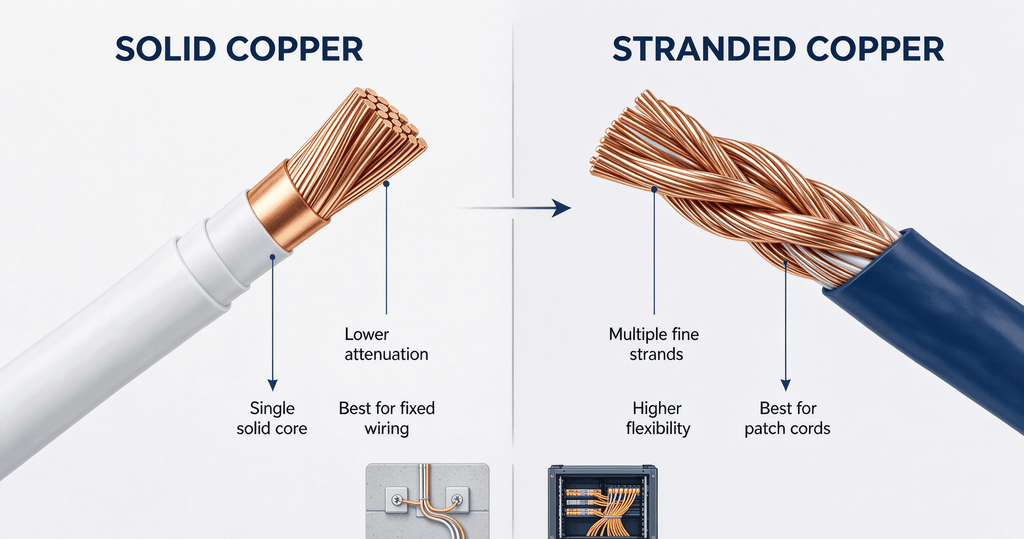
Solid vs stranded copper ethernet cable is one of the most common confusing topics for network buyers. When sourcing Cat5e, Cat6, Cat6A and Cat7 network cables, many system integrators and procurement engineers overlook one critical detail: the copper conductor construction. The choice between solid and stranded copper directly impacts signal stability, bending lifespan, PoE performance and whether your cable can pass Fluke certification. Selecting the wrong conductor type leads to unexpected packet loss, early cable failure and costly rework. In this guide from our ethernet cable factory, we break down the core differences, compare their pros and cons, and share clear application rules to help you pick the right cable for fixed structured wiring, cabinet patch connections and industrial automation projects.
What Is Solid Copper Ethernet Cable?
Solid copper ethernet cable uses one single solid copper wire per conductor. It is also known as solid-core network cable, mostly supplied as bulk cable for permanent fixed wiring.
Solid copper delivers stable electrical performance. It has lower DC resistance and consistent impedance, which helps maintain signal integrity over long transmission distances. It works well with keystone jacks, wall outlets and panel termination.
However, solid copper is stiff and not tolerant of repeated bending or movement. Once bent back and forth many times, the single copper core is easy to fracture internally.
✅ Best use cases for solid copper ethernet cable
- Permanent in-wall, ceiling and under-floor fixed cabling
- Long-distance static wiring for data center racks
- Fixed LAN infrastructure for office, school and warehouse
- Long-run PoE camera fixed installation
❌ Not recommended
- Patch cords for frequent plugging and movement
- Dynamic moving equipment, drag chain and robotic cabling
What Is Stranded Copper Ethernet Cable?
Stranded copper ethernet cable is built with multiple thin fine copper wires twisted together to form one conductor. It is the standard conductor material for finished network patch cords.
Multi-strand design brings excellent flexibility and bending resistance. The fine copper strands disperse bending stress, so the cable can withstand thousands of flex cycles without conductor breakage. That is the main reason patch cords always use stranded copper.
The trade-off: stranded copper has slightly higher electrical resistance than solid copper of the same AWG. Its signal attenuation is a little higher, so it is less ideal for very long fixed runs.
This high-flex multi-strand design is also critical for robot torsion motion cables working under continuous multi-axis movement.
✅ Best use cases for stranded copper ethernet cable
- Finished patch cords for cabinet, switch and desktop connection
- Temporary wiring and frequently reconfigured networks
- industrial ethernet cables for automation cabinets with limited movement
- Field test wiring, portable network connection
❌ Not recommended
- Long-distance permanent bulk cabling over 90m
- Projects that require the lowest signal attenuation for 10Gbps long runs
Core Comparison Table: Solid VS Stranded Copper Ethernet Cable
| Feature | Solid Copper Ethernet Cable | Stranded Copper Ethernet Cable |
|---|---|---|
| Conductor structure | Single solid copper wire | Multiple twisted fine copper strands |
| Flexibility | Stiff, rigid | Highly flexible |
| Bending endurance | Poor, easy to break after repeated flex | Excellent, suitable for frequent movement |
| Signal attenuation | Lower, better for long runs | Slightly higher |
| Typical product form | Bulk cable, UTP/STP solid cable | Finished patch cord, jumper cable |
| Termination | Fits keystone jack, wall outlet | Fits RJ45 plug crimping for patch cords |
| PoE performance | Stable for long fixed PoE runs | Suitable for short PoE patch connection |
Common Buying Mistakes To Avoid
Mistake 1: Using solid bulk cable to make homemade patch cords
Solid copper cracks quickly if you keep bending it at the RJ45 plug end. Even if crimped successfully, it will fail within a short time. Finished patch cords must adopt stranded conductor.
Mistake 2: Using stranded bulk cable for long fixed in-wall wiring
Stranded cable brings extra attenuation. For Cat6A 10Gbps long-distance static wiring, solid copper is the preferred choice to pass Fluke certification.
Mistake 3: Mixing conductor requirements in industrial projects
Static industrial field wiring can use solid shielded cable. If the cable needs to move with machinery, you have to choose stranded high-flex industrial ethernet cables.
FAQ
Q1: Which one is better for PoE, solid or stranded ethernet cable?
Solid copper is preferred for long fixed PoE runs such as IP cameras. Stranded copper works fine for short PoE patch cords between switch and device. Both support PoE, PoE+ and PoE++ as long as they are pure bare copper and correct AWG.
Q2: Can solid copper cable pass Fluke test?
Yes. Standard solid bare copper bulk cable usually achieves good Fluke test results and certification, as its impedance and return loss performance are more stable.
Q3: Is stranded copper always thinner AWG?
No. AWG defines the total cross-sectional area. You can find both solid and stranded conductors in 23AWG, 24AWG, 26AWG and 28AWG. AWG is independent of solid/stranded structure.
Q4: Can solid/stranded cable also be CCA?
Yes. CCA cable can be made in both solid and stranded form. Conductor structure does NOT guarantee pure copper material. If you want to learn how to distinguish them, check our guide on bare copper vs CCA ethernet cable.
Final Selection Checklist
- Fixed long run in-wall cabling → Choose solid copper ethernet cable
- Patch cords, jumpers, frequent reconnection → Choose stranded copper ethernet cable
- Static 10Gbps Cat6A permanent installation → Solid copper
- Flexible cabinet jumper & short dynamic connection → Stranded copper
If you need custom Cat6, Cat6A, Cat7 patch cords or bulk ethernet cables with solid / stranded bare copper conductors, contact our team for quotation and samples.