
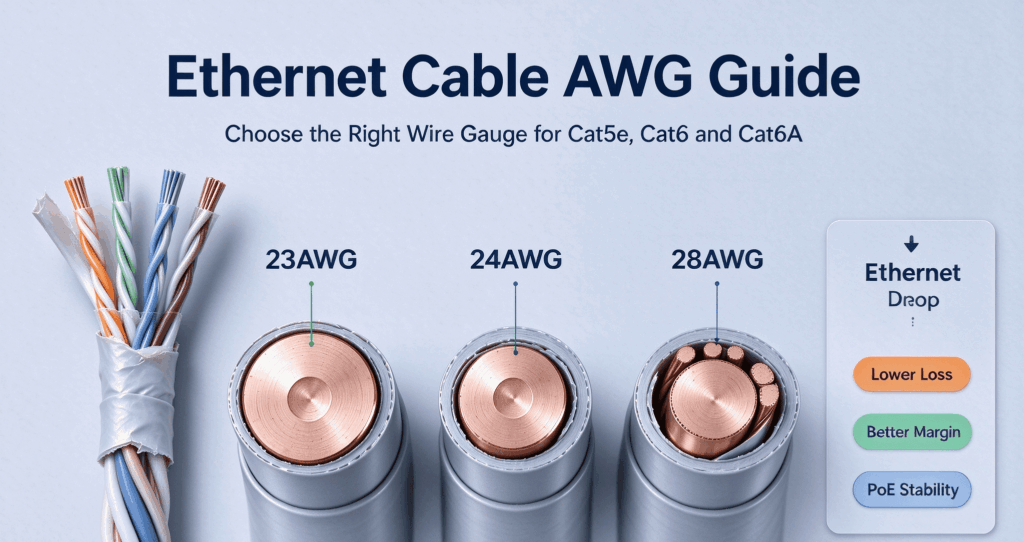
This ethernet cable AWG guide breaks down everything you need to know to select the correct conductor gauge for your network wiring. If you’ve ever browsed network cable specs, you must have noticed the AWG marking printed on the jacket. Many buyers only focus on the cable category: Cat5e, Cat6 or Cat6A, ignoring that AWG wire gauge is a critical hidden factor that decides whether your cable can pass certification, support stable PoE power supply and work well at your planned transmission distance.
What is AWG for ethernet cables? AWG stands for American Wire Gauge. The rule is simple: the smaller the AWG number, the thicker the copper conductor. Thicker copper brings lower DC resistance, less insertion loss and better heat tolerance, while thinner AWG wires are softer, smaller in outer diameter and easier for high-density patch panel management. AWG selection is essentially a balance between attenuation specs, bandwidth, PoE load, installation scenarios, flexibility and budget.
What standard rules define the attenuation limit of different AWG?
Standards including TIA-568 and ISO 11801 set strict maximum insertion loss thresholds for each cable category at specific frequency bands. Higher frequency signals suffer more attenuation, which means you need thicker copper conductors to reserve enough margin for signal transmission.
- Cat5e: 100MHz, commonly 24AWG, meets 1Gbps transmission up to 100 meters
- Cat6: 250MHz, mainstream 23AWG, stable 1Gbps at 100m, supports 10Gbps for short runs up to 55m
- Cat6A: 500MHz, almost always 23AWG for factory-certified cables, delivers reliable 10Gbps full 100m links
- Cat7 / Cat7A: 600MHz / 1000MHz, usually 23AWG, paired with shielded construction to control crosstalk and loss
- Cat8: 2000MHz, extremely high frequency loss, adopts 22–23AWG, limited to 30m for 25G/40G links
One common trap worth noting: you can also find Cat6 cables marked 24AWG on the market. They can still run 1Gbps, but leave far less testing margin. In long-distance runs, high-temperature environments or bundled with dozens of other cables, this type of thin-conductor Cat6 is much easier to fail Fluke certification. If you are looking for certified high-frequency cabling, learn more about Cat6A shielded ethernet cable. You can review ANSI/TIA-568 structured cabling attenuation and DC resistance specs for formal limits for each category and conductor gauge.
How does AWG affect PoE, voltage drop and heat generation?
PoE transmits power over the same copper conductors that carry data, and its performance mainly depends on the DC resistance of solid copper. Thinner conductors such as 26AWG and 28AWG have higher resistance. This leads to larger voltage drop and more heat build-up on the cable.
- PoE (15.4W) & PoE+ (30W): 24AWG works for most regular indoor deployments
- High density, long cable runs or PoE++ (60W): 23AWG is the preferred option for safety and stability
- 28AWG slim patch cords: Not recommended for high-power PoE applications. Refer to PoE cabling thermal and AWG sizing guidance from Cisco for bundle derating rules on high-power PoE deployment.
Should I pick different AWG for permanent links and patch cords?
Absolutely yes. These two wiring types have totally different design priorities.
- Permanent horizontal cabling (wall runs, tray routing, fixed 90m links): 23AWG / 24AWG solid copper is the standard choice. Solid copper delivers low loss and abundant testing margin for long-term stable network operation.
- Short patch cords for rack and device interconnection: Multi-strand stranded copper in 26AWG or 28AWG slim versions is widely used. The advantage is great flexibility and small OD, making cable management cleaner in crowded server racks. The trade-off is reduced 10G transmission distance, so slim cords are only suitable for short patch connections of several meters. For dense rack wiring, Cat6 slim patch cord is a popular option for installers.
What physical constraints do I need to consider for AWG selection?
AWG also changes the physical properties of your ethernet cable, which directly impacts construction:
- 23AWG: Thick conductor, stiffer, harder to bend, takes up more space in conduits, higher copper cost. Best for fixed pre-installed horizontal cabling.
- 26AWG / 28AWG: Thin conductor, flexible, compact outer diameter, perfect for high-density patch panels. But higher signal attenuation and smaller performance margin, limited for short patch use only. For industrial motion cables used in robotic drag chains, AWG is not the only factor. Engineers have to balance current carrying capacity, flexibility and repeated bending resistance. Check our range of industrial drag chain ethernet cable for continuous motion networking.
Does temperature and cable bundling change my AWG choice?
Yes, this is a frequently overlooked point. Copper resistance rises when temperature goes up, which worsens signal attenuation. If dozens of network cables are tightly bundled together, heat cannot dissipate efficiently, and the thermal risk is amplified. For high-temperature sites or large bundled cable trays, it is safer to step up to a thicker AWG to reserve extra safety margin, to avoid Fluke test failure and overheating hazards for PoE circuits.
AWG Quick Selection Table
| Cable Spec | Common AWG | Core Reason |
|---|---|---|
| Cat5e UTP Permanent Cable | 24AWG | 100MHz attenuation meets gigabit requirement, cost-effective |
| Cat6 UTP Permanent Cable | 23AWG | 250MHz bandwidth, reserved margin for short-run 10G |
| Cat6A UTP/FTP Permanent Cable | 23AWG | Handles heavy 500MHz high frequency, guarantees 10G@100m certification |
| Slim Cat6 / Cat6A Patch Cord | 26AWG / 28AWG | Flexible, small OD for dense rack management, only short distance |
| Industrial Drag Chain Ethernet Cable | 24AWG (custom) | Balance of current load, flex life and signal performance |
Quick tips before finalizing your cable AWG
- Confirm your target bandwidth, speed and total channel length first
- Check if the project requires PoE / PoE++ power supply
- Distinguish permanent in-wall cabling or short rack patch cord
- Count cable bundle quantity and check ambient temperature
- Reserve extra test margin if Fluke certification is mandatory
FAQ
- Is 23AWG always better than 24AWG for ethernet cables? Not always. 23AWG has better electrical performance, but it is stiffer and costs more. 24AWG is enough for standard Cat5e and many regular Cat6 gigabit deployments with a tighter budget.
- Can 28AWG slim Cat6 cable run PoE++? It is not recommended. High resistance on 28AWG creates big voltage drop and overheating risk. Save slim thin-gauge cords for low-power, short-distance patch connections only.
- Can a 24AWG Cat6 cable pass Fluke certification? It is possible under ideal conditions, but the margin is much smaller than 23AWG Cat6. It may fail testing in long runs, bundled routing or high-temperature environments.
- What AWG should I choose for industrial robotic ethernet cables? Most industrial motion ethernet cables adopt customized 24AWG stranded copper. It balances PoE carrying capacity, repeated bending life and signal stability.
- Does Cat6A always require 23AWG conductor? For standard 10G@100m certified Cat6A, 23AWG is the mainstream specification. Thinner AWG Cat6A usually sacrifices transmission distance and testing margin.