
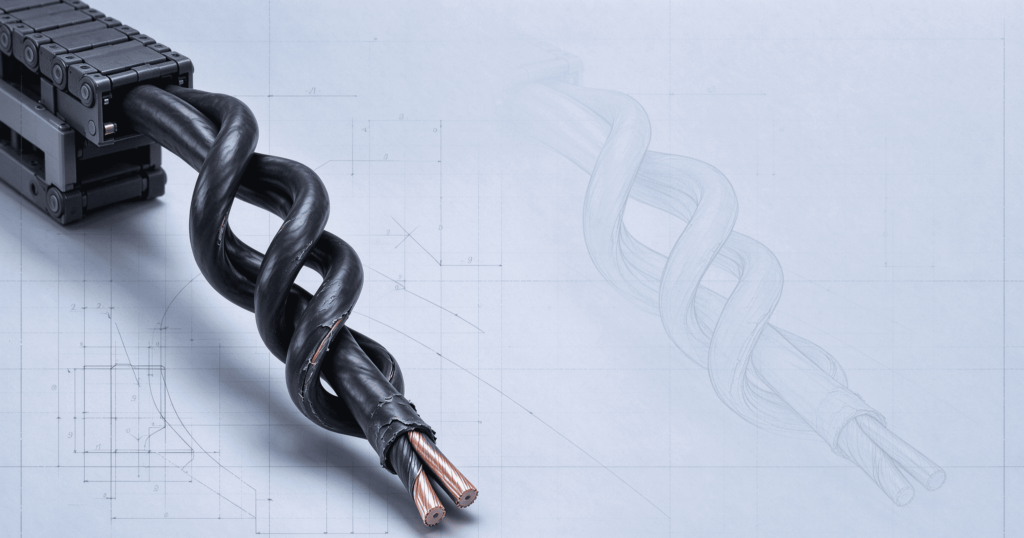
High flex cable corkscrewing is a frustrating irreversible torsion failure that frequently happens on drag chain cables and multi-axis robot continuous flex cables. Have you ever pulled a failed drag chain cable out of an energy chain, only to find it twisted into a permanent spiral, just like a wine corkscrew?
Unlike minor jacket scratches or surface abrasion, corkscrewing damage is mostly irreversible. Once a high flex cable develops this helical deformation, internal conductors have already shifted and accumulated torsional stress. If you keep running it in the drag chain, it will bind inside the chain, rub heavily against adjacent cables, and quickly lead to core breakage, signal interruption or unexpected machine downtime.
In this guide, we break down exactly what corkscrewing is, where it comes from, and actionable rules you can follow to prevent it from happening on your automation projects.
What Exactly Is Cable Corkscrewing?
Corkscrewing describes the permanent helical, screw-shaped distortion along the whole length of a high flex cable. It occurs after thousands or millions of repeated bending cycles inside energy chains or multi-axis robotic dress packs.
Inside a well-designed continuous flex cable, every stranded conductor, filler and jacket stays in its fixed relative position during flexing. When corkscrewing triggers, the internal stranding structure loses balance. Individual cores migrate and shift radially, releasing built-up torsional force stored during cable cabling. The cable then twists itself into a spiral shape externally.
It is critical to distinguish corkscrewing from temporary twist:
- Temporary twist: Cable twists when you install it, but can be released by unwinding. It usually leaves no permanent damage.
- Corkscrewing: Permanent plastic deformation. Even after you remove tension and straighten the cable, the spiral shape will bounce back. The internal copper conductors and insulation layers have already been permanently displaced.
This distinction matters because many maintenance teams initially dismiss spiral deformation as “just twist.” In reality, corkscrewing is an advanced structural failure that usually requires cable replacement.
What Are The Main Causes of Corkscrewing on High Flex Cables?
Corkscrewing rarely comes from a single factor. It usually combines cable structural defects, wrong product selection and installation mistakes.
1. Poor Cable Stranding & Construction Design
This is the root manufacturing cause. Traditional layered stranding is far more vulnerable to corkscrewing than bundled, concentric balanced stranding.
If the lay length, lay direction of twisted pairs and inner filler are not perfectly matched, residual torsion locks inside the cable during production. Once the cable bends repeatedly in drag chains, this stored torsion releases gradually and pushes the cable into spiral deformation.
Cables without central strength members or pressure-extruded jackets also have higher risk, because there is no stable structure to lock internal cores in place during cyclic movement.
2. Wrong Cable Selection
A huge proportion of corkscrew failures come from misselection. Ordinary flexible control cables or static wiring cables are only designed for occasional bending, not millions of continuous flex cycles. They do not have balanced torsion-resistant stranding. Once installed in drag chains, corkscrewing often appears after just a few thousand cycles.
For linear moving applications, always specify a true high flex drag chain cable rather than a standard flexible cable. For multi-axis robots, choose a torsion-resistant robot cable instead.
3. Installation & Routing Mistakes
Even premium continuous flex cables can corkscrew if installed incorrectly:
- Pre-twisted cable during spool unwinding: Pulling cable sideways off a spool instead of rolling the reel will introduce hidden pre-torsion.
- Overfilled energy chain: Too many cables packed tightly inside the chain prevent free movement during bending.
- Incorrect strain relief: Fixed ends are clamped too tight or allowed to rotate, so torsion cannot be released at both ends.
- Too small dynamic bend radius: Running cable below the manufacturer’s minimum dynamic bend radius will overload internal cores and break the balanced stranding structure.
4. Multi-axis Torsion Movement on Robot Applications
For 6-axis robot dress packs, axis 4/5/6 rotation brings continuous axial torsion. Standard drag chain cables without anti-torsion design cannot absorb rotational stress. Torsion accumulates cycle after cycle, triggering corkscrewing rapidly if swivel relief structures are missing.
What Risks Does Corkscrewing Bring to Automation Systems?
Many maintenance teams underestimate how dangerous this spiral deformation can be. The risks extend far beyond cosmetic damage.
1. Cable Binding Inside Energy Chain
The spiralled cable effectively becomes shorter in travel. During forward and reverse movement, it can pull tight inside the chain, causing links to jam, bend or crack. In severe cases, the cable may lock the entire drag chain system.
2. Accelerated Conductor Fatigue Breakage
Corkscrewing concentrates stress on twisted copper strands. Over time, this leads to intermittent signal loss, unstable power supply or sudden conductor breakage. For control and data circuits, the result is often unpredictable machine stops.
3. Abrasion and Jacket Tearing
The raised spiral peaks rub constantly against chain walls and neighbouring cables. This creates localised abrasion that can wear through the jacket and reach inner insulation much faster than uniform flex wear.
4. Unplanned Production Downtime
When drag chain cable corkscrew effect advances to core failure, production stops unexpectedly. The affected robot, gantry or transfer line may remain idle until technicians locate the fault, replace the cable and recommission the system.
5. Higher Long-Term Cost
Frequent cable changeouts, spare part inventory, labour costs and lost production output make corkscrewing an expensive hidden failure. Prevention is always more cost-effective than repeated replacement.
Practical Tips to Prevent High Flex Cable Corkscrewing
Corkscrewing is preventable if you control cable design, selection and installation step by step.
1. Choose Balanced Bundled-Stranding Continuous Flex Cables
Prioritise cables with bundled, balanced concentric stranding, rather than simple layered stranding. This construction distributes bending stress evenly and minimises residual torsion inside the cable.
For rotary robotic axes, select dedicated torsion-resistant robot cables instead of standard linear flex cables. Matching cable construction to the actual movement type is the most important design decision.
2. Follow Correct Unwinding Rules From Cable Spools
Always roll the spool to pay out cable straight, never pull cable sideways off the reel. This simple step avoids introducing hidden pre-twist before installation. After laying, manually check and release any residual twist before clamping strain relief.
3. Control Energy Chain Fill Rate & Bend Radius
Keep total cable fill rate inside energy chain under 60%. Leave enough clearance so cables can shift freely without squeezing. Always follow the dynamic minimum bend radius specified by the cable datasheet, not static bend radius.
4. Proper Strain Relief & End Fixing
Secure both moving end and fixed end with proper strain relief clamps, preventing cable rotation at termination points. For long travel chains, add quiet zones at both ends to absorb stress transition.
5. Separate Cables With Different Flex Characteristics
Do not mix stiff power cables, thin data cables and high-flex control cables tightly together in one chain. Different elongation and flex behaviours will create uneven friction and torsion transfer between cables.
You can find more practical engineering advice on dynamic cable service life from this high flex cable torsion failure guide from IEWC.
FAQ
Q1: Can I repair a corkscrewed high flex cable and reuse it?
Generally no. Corkscrewing creates permanent internal core displacement. Even if you manually straighten the spiral, residual torsion remains. It will deform again quickly under flexing and risk sudden conductor breakage. Replacement is the only reliable fix.
Q2: Is corkscrewing the same as birdcaging?
No. Birdcaging usually refers to braid shielding expansion and opening; corkscrewing is longitudinal helical deformation of the whole cable body. Both are torsion-related failures but show different symptoms.
Q3: How long does it take for corkscrewing to show up after installation?
It depends on cable quality, movement speed and cycle count. Poorly matched cables may show corkscrewing within hundreds of thousands of cycles; well-selected balanced flex cables can run millions of cycles without this issue.
Q4: Can cable jacket material stop corkscrewing?
Jacket material improves abrasion and oil resistance but cannot eliminate corkscrewing. The core anti-corkscrew property mainly relies on internal stranding balance and structure design.
Q5: What’s the difference between linear drag chain cable and torsion robot cable?
Linear drag chain cables are optimised for back-and-forth bending movement. Torsion robot cables adopt special reverse-lay balanced structure to absorb continuous axial rotation, which is essential for multi-axis robotic wrists.
Conclusion
Corkscrewing remains one of the top hidden pain points for automation cable users. It is not just a cosmetic twist; it is a warning sign that your cable’s internal balanced structure has failed.
The good news is that most corkscrew failures are avoidable, not inevitable. Start from the cable selection stage: pick properly balanced bundled-stranding high flex cables, match the cable type to your movement type, follow standard unwinding and strain relief rules, and keep reasonable space inside energy chains. These engineering habits will drastically reduce premature cable failure and cut your factory’s maintenance downtime.