
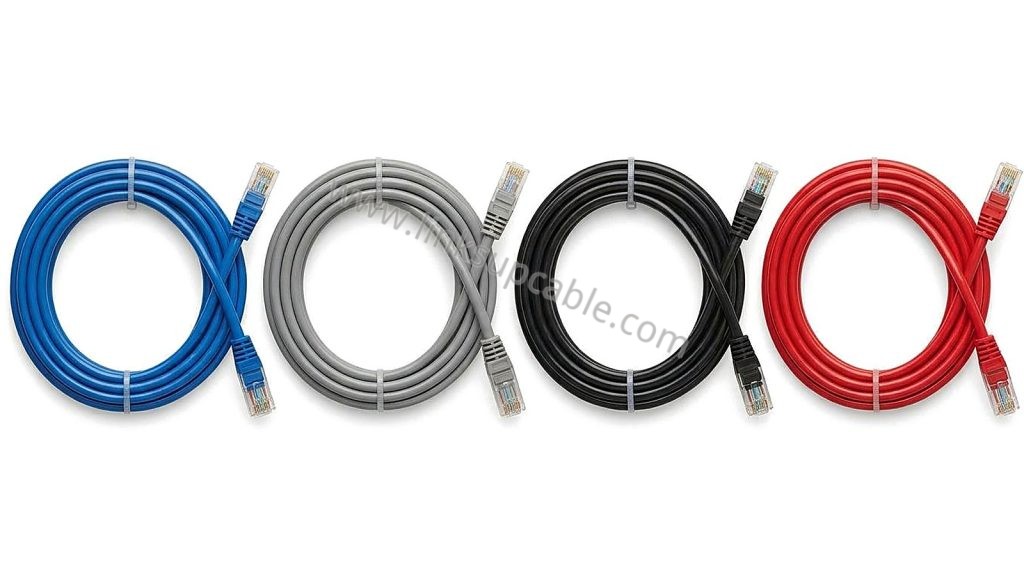
Every week we receive enquiries that open with the same sentence: “We need the fastest Ethernet cable you make.” It is an understandable request, and it is almost always the wrong specification. The fastest category available is not the correct choice for most projects, and buying it anyway can waste a large part of a cabling budget while delivering no measurable improvement. This guide explains what actually separates Cat6, Cat6A, Cat7 and Cat8, written from the perspective of a factory that manufactures all four every day.
The Short Answer
If you want the decision without the reasoning, here it is. Choose Cat6 for gigabit networks in homes, offices, hotels and retail where budget matters. Choose Cat6A for any new commercial installation that should still be adequate in ten years, and for every Wi-Fi 6E or Wi-Fi 7 access point. Treat Cat7 as a legacy specification you probably do not need. Choose Cat8 only for short, high-speed links inside a data centre rack. For the majority of buyers reading this, the correct answer is Cat6A.
Comparison Table at a Glance
| Specification | Cat6 | Cat6A | Cat7 | Cat8 |
|---|---|---|---|---|
| Bandwidth | 250 MHz | 500 MHz | 600 MHz | 2000 MHz |
| Max data rate | 1 Gbps (10G to 55 m) | 10 Gbps | 10 Gbps | 25 / 40 Gbps |
| Max distance at top speed | 55 m for 10G | 100 m | 100 m | 30 m |
| Shielding | UTP or F/UTP | F/UTP or S/FTP | S/FTP only | S/FTP only |
| Connector | RJ45 | RJ45 | RJ45 / GG45 / TERA | RJ45 |
| Recognised by TIA | Yes | Yes | No | Yes |
| Typical conductor | 23–24AWG | 23AWG | 23AWG | 22–24AWG |
| Relative cost | 1.0× | 1.4× | 1.7× | 2.5× |
| Best suited to | Home, small office, gigabit | Enterprise, PoE++, new builds | Legacy European projects | Data centre rack links |
Cat6: The Gigabit Workhorse
Category 6 is tested to 250 MHz and carries gigabit Ethernet across the full 100 metre permanent link without difficulty. It will also run 10GBASE-T, but only to roughly 55 metres, and only when interference from neighbouring cables is low — a condition that rarely holds in a tightly bundled ceiling run. In practice, treat Cat6 as a gigabit cable that can occasionally do 10G over short distances.
That is not a criticism. The overwhelming majority of network ports installed worldwide still operate at 1 Gbps, and the switch, router or laptop at the end of the cable is almost always the limiting factor rather than the copper. For homes, small offices, hotel rooms, classrooms, retail sites and IP telephony, Cat6 delivers everything the hardware can use at the lowest cost per metre. Our Cat6 patch cords and Cat6 flat patch cables remain our highest-volume products for exactly this reason.
Where Cat6 becomes a false economy is in new commercial construction. The cable itself is a small fraction of an installation budget; the labour to pull it through a finished building is the expensive part. Saving a modest amount on cable today, then paying for a second pull in five years, is a poor trade.
Cat6A: The Right Answer for Most Commercial Projects
Category 6A doubles the tested bandwidth to 500 MHz and, critically, adds mandatory alien crosstalk performance — interference between adjacent cables in the same bundle, which is the dominant failure mode at 10 Gigabit speeds. The result is a cable that certifies 10GBASE-T across the entire 100 metre channel rather than the 55 metres Cat6 manages.
The practical rule we give clients: if the building will outlive the current generation of switches, specify Cat6A. The material cost premium over Cat6 is roughly 40%. The cost of re-pulling horizontal cable is several times the original installation.
There is a second reason Cat6A has become the default. Wi-Fi 6E and Wi-Fi 7 access points now routinely need multi-gigabit uplinks and draw serious power over the same cable. Power over Ethernet at the 802.3bt level delivers up to 90 watts, and that current has to travel through the copper without raising the temperature of the bundle beyond specification. The heavier 23AWG solid copper conductor used in Cat6A handles that load with far more margin than thin or copper-clad alternatives.
Cat6A is available in F/UTP, with a single overall foil, which suits standard office environments, and in S/FTP, where each pair carries its own foil inside an overall braid, for factory floors, hospitals, broadcast facilities and any run alongside mains power. For high-density racks our Cat6A slim flat patch cables reduce cross-sectional area by around 40% compared with round cord, which matters when forty-eight of them terminate in the same panel.
Cat7: Why We Usually Advise Against It
This is the category that causes the most confusion, so it is worth being direct. Category 7 was defined by ISO/IEC, not by TIA, and it was never recognised as a standard cabling category in North America. In its original specification it does not even use an RJ45 connector; it uses GG45 or TERA connectors that virtually no switch, router or wall plate accepts.
What is sold as “Cat7” in most online listings is therefore something else: Cat7-grade bulk cable terminated with ordinary RJ45 plugs. That combination is not a certifiable Cat7 channel. It is, in engineering terms, a well-shielded cable performing at approximately Cat6A level — which is fine, but it means you are paying a premium for a label rather than for measurable performance.
There are legitimate uses. Some European and Middle Eastern specifications still call for Cat7 or Cat7A by name, and installed bases exist that must be matched. We manufacture a full Cat7 patch cord range for exactly those projects. But if you are specifying a new network from scratch and nobody has written “Cat7” into a tender document, Cat6A will give you equivalent real-world performance with full standards compliance and better connector availability.
Cat8: A Data Centre Specification, Not a Home Upgrade
Category 8 is a genuine TIA standard and a genuinely impressive cable: 2000 MHz of bandwidth and 25 or 40 Gbps of throughput, four times the frequency band of Cat6A. It is also limited to a 30 metre channel, because those frequencies simply do not survive further over copper.
That distance limit defines its purpose. Cat8 exists for top-of-rack and end-of-row links inside data centres — server to switch, switch to switch, over a few metres. It is not a horizontal cabling solution, and it cannot reach from a floor cabinet to a desk.
We sell a great deal of Cat8 into the consumer and gaming market, and we are straightforward with those customers about what it does. Plugging a Cat8 cable into a 1 Gbps router port will not make the connection faster, because the ports set the line rate, not the cable. What you do get is very heavy electrical headroom, excellent shielding in electrically noisy homes, and a link that will not need replacing when multi-gig hardware arrives. If that reasoning appeals, our Cat8 patch cords and Cat8 flat cables are built for it. If you were expecting a speed increase on existing gigabit equipment, you will not see one.
The Specifications That Matter More Than the Category
Two cables can both be labelled Cat6 and perform completely differently. Before comparing categories, check these four things — they affect real installations more than moving up a category number.
1. Bare Copper, Not Copper-Clad Aluminium
This is the single largest quality variable in the market. CCA uses an aluminium core with a thin copper coating. It looks identical once jacketed and will pass a basic continuity test, which is precisely why it keeps arriving on job sites. It also has around 55% higher DC resistance than copper, fails PoE temperature-rise limits in bundles, work-hardens and snaps at the punch-down, and is prohibited for permanent installation under many electrical codes. A quick field check: a 1000ft box of genuine 23AWG solid bare copper Cat6 weighs roughly 11–13 kg, while CCA comes in around 7–8 kg. Nick a conductor — copper stays copper-coloured through the cut, CCA shows silver aluminium underneath.
Why we refuse to build CCA — read more
2. Solid Versus Stranded Conductors
Solid conductor cable belongs in permanent horizontal runs terminated into punch-down jacks and patch panels; it has lower attenuation and is what the standards assume for the 90 metre link. Stranded conductor cable belongs in patch cords, where flexibility matters. Punching stranded cable into an IDC jack produces intermittent faults that are extremely difficult to diagnose later, and using solid cable as a movable patch lead will eventually fracture it. Our bulk ethernet cable ships in solid conductor for exactly this reason.
3. Shielding: UTP, F/UTP or S/FTP
UTP has no shield and is lighter, cheaper and easier to terminate — the right choice for ordinary office environments. F/UTP adds a single overall foil, useful once you reach 10G. S/FTP foils each pair individually inside an overall braid and is what you want near motors, variable-frequency drives, lift shafts or heavy mains runs. One caution: a shielded cable only works if the shield is properly bonded and grounded at the rack through shielded jacks. A shielded cable terminated into unshielded hardware gives you the cost without the benefit.
4. Jacket Fire Rating
This is a code compliance matter, not a preference. CMR riser rating covers general indoor and vertical runs between floors. CMP plenum rating is mandatory where cable passes through air-handling spaces such as HVAC return ceilings and raised floors — if an inspector finds CMR in a plenum, the installation fails. LSZH is specified throughout Europe, the Middle East and in public-building and transport tenders for low-smoke, halogen-free behaviour during evacuation. Confirm the requirement before production, not after inspection.
Choosing by Application
| Scenario | Recommended | Reasoning |
|---|---|---|
| Home network, gigabit router | Cat6 | Matches what the hardware can actually deliver |
| Home, futureproofing or heavy interference | Cat6A | Shielded, 10G-ready, modest premium |
| Office and commercial new build | Cat6A | Full-distance 10G; labour cost dominates cable cost |
| Wi-Fi 6E / Wi-Fi 7 access points | Cat6A | Multi-gig uplink plus PoE++ power headroom |
| PoE++ cameras and lighting | Cat6A solid bare copper | 23AWG copper controls temperature rise in bundles |
| Data centre, rack to rack under 30 m | Cat8 | 25/40G within its distance envelope |
| Horizontal run over 30 m | Cat6A, never Cat8 | Cat8 is not certifiable beyond 30 m |
| Tender specifies Cat7 by name | Cat7 | Compliance requirement rather than technical one |
| Industrial floor, high EMI | Cat6A S/FTP | Individually foiled pairs plus overall braid |
| Gaming console or PC | Cat6 or Cat6A | Latency is set by the connection, not the cable category |
Frequently Asked Questions
Will a higher category cable make my internet faster? No. Your line rate is set by your internet service, router, switch and network card. Cable category sets the ceiling, not the speed. Upgrading from Cat6 to Cat8 on a gigabit connection changes nothing measurable.
Is Cat7 better than Cat6A? On paper it has more bandwidth. In practice, Cat7 is not a TIA-recognised category and is almost always sold with RJ45 connectors that its own specification does not use, which means the channel cannot be certified as Cat7. For new projects Cat6A is the better engineering and commercial choice.
Can I mix categories in one network? Yes, and everything is backward compatible, but the whole channel performs at the level of its weakest component. A Cat6A permanent link patched with Cat5e cords is a Cat5e channel.
Do I need shielded cable at home? Usually not. UTP is fine in typical residential conditions. Consider shielded cable if runs pass close to mains wiring, large appliances or fluorescent fittings.
How long can each category run? All categories use the 100 metre channel limit for their standard speed. The difference appears at 10 Gigabit: Cat6 reaches around 55 m, Cat6A and Cat7 reach the full 100 m, and Cat8 is limited to 30 m at its 25/40G rates.
What does the AWG number mean? It is conductor thickness, and lower numbers are thicker. 23AWG is standard for Cat6A bulk cable; 28AWG is common in slim patch cords, trading a little insertion-loss margin for much better rack density.
Specifying With a Manufacturer
When you send us a specification, five details let us quote accurately the first time: category, shielding type, conductor gauge and material, jacket fire rating, and length or packaging format. Everything else — jacket colour, printed branding, boot style, retail packaging — is customisable.
Every batch we produce is tested on Fluke analysers for NEXT, return loss, insertion loss and delay skew, and the report can ship with your order. You can see the equipment we use on our testing laboratory page, and the full OEM and ODM process on our services page. If you are still unsure which category suits your project, describe the application and the distances involved and we will tell you the appropriate specification — including when the cheaper one is the right answer.