
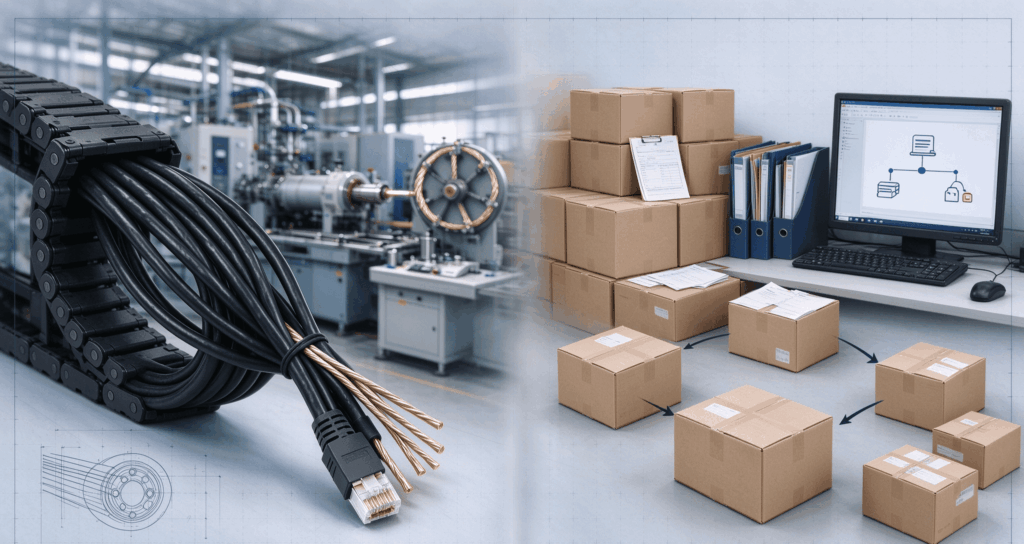
If you are a distributor, system integrator or project buyer comparing ethernet cable factory vs trading company while sourcing ethernet patch cords, industrial network cables and high-flex cables from China, you have probably run into this common headache: is this supplier a real ethernet cable manufacturer, or just a trading company reselling goods from third-party workshops? Many buyers mistakenly assume that all suppliers showing factory photos online are cable factories. Choosing the wrong supplier will bring hidden troubles: unstable cable performance, inconsistent Fluke test results, long lead times, limited customization support and unexpected quality risks. Knowing the differences between an ethernet cable factory and a trading company helps you reduce sourcing risk and lock in stable supply for your business.
What Makes The Difference: Ethernet Cable Factory vs Trading Company?
Before jumping into inspection methods, it is necessary to clarify their essential boundaries. An ethernet cable factory owns production lines, extrusion machines, twisting equipment, termination stations and in-house testing labs. They control the whole production flow from raw copper, cable jacket extrusion, pair twisting, connector crimping, electrical testing to final packing. They can adjust raw material specs, custom jacket colors, print custom logos and provide full test reports according to buyer requirements.
A trading company does not run production workshops. They source finished or semi-finished ethernet cables from multiple external factories, then rebrand and resell them to overseas buyers. They act as middlemen. Some trading companies have good supply chains, but they cannot directly control production parameters, and their ability for complex customization is usually limited.
| Check Item | Ethernet Cable Factory | Trading Company |
|---|---|---|
| Production Equipment | Own extrusion, twisting, crimping, testing machines | No self-owned production lines |
| Customization Service | Support custom AWG, jacket material, logo printing, special connectors, Custom Patch Cord | Mostly standard stock items; complex custom orders need to forward to factories |
| Test Capability | In-house Fluke tester, cable continuity, impedance test, full batch inspection | Rely on third-party factory to provide test reports |
| Lead Time Control | Stable and adjustable lead time | Depends on the schedule of its upstream manufacturers |
| Price Structure | Raw material + production + packing cost, transparent | Extra middleman markup |
| Risk Control | Directly trace every production batch | Hard to control quality if changing sub-suppliers frequently |
How To Verify Ethernet Cable Factory vs Trading Company In 6 Practical Checks
1. Ask for on-site live video tour of the workshop
Photos and factory videos on Alibaba or the website can be reused or purchased from other manufacturers. The most straightforward check is requesting a real-time live video call. Focus on these areas: raw copper storage warehouse, jacket extrusion line, cable twisting area, RJ45 crimping workstation, finished product testing station and stock warehouse. A genuine factory can show these areas anytime. Trading companies often make excuses such as “workshop is not allowed to visit” or “production area is under renovation”.
2. Dig into customization capacity
This is one of the most obvious distinguishing points. Real ethernet cable factories support deep customization. You can raise professional requests: change LSZH / PUR / PVC outer jacket, adjust conductor AWG, custom cable length, custom print logo and part number on cable outer skin, special shielding structure for Cat6A or industrial high-flex cables.
If your supplier can support these requirements and provide Custom Patch Cord solutions with detailed technical confirmation, it is highly likely a manufacturer. Most trading companies can only offer ready-made standard patch cords and cannot modify core cable parameters freely.
3. Request full batch test reports and audit documents
Ask for factory audit records, production process records and batch Fluke certification. A real factory can provide test reports marked with their own factory name and production batch number. Many trading companies share generic test reports copied from their suppliers. If the report company name is different from your supplier’s business license name, it is a warning sign. For formal performance validation, all structured network cables should comply with IEC standards for twisted pair ethernet cables.
4. Check business license and export scope
Check the Chinese business license (Business Registration Certificate). The business scope of a cable factory usually contains words like “cable and wire manufacturing, communication cable production”. Trading companies’ scope only includes “sales, import and export of electronic products”, without manufacturing items.
5. Confirm MOQ for custom orders
Factories usually separate MOQ for standard stock cables and custom branded cables. They can tell you the exact minimum order quantity for custom extrusion, custom printing and special cable structures. Trading companies often give vague MOQ answers, because the MOQ is set by their upstream factory instead of themselves.
6. Check after-sales & technical support
Real ethernet cable factories have internal engineers. When you meet problems like voltage drop for PoE cables, crosstalk failure or corkscrewing on high-flex cables, their technical team can analyze root causes and adjust production process. Trading companies can only forward your complaints to upstream factories and cannot give immediate technical diagnosis. Most commercial ethernet wiring projects follow TIA-568 cabling specification for structured cabling.
What Risks Will You Face If You Work With An Unreliable Trading Company?
Not all trading companies are bad. Some professional traders cooperate with stable factories and offer good service. But there are several common risks you need to watch out for:
- Spec downgrade risk: They promise pure copper Cat6 cable, but source CCA copper-clad aluminum cable to cut cost.
- Unstable consistency: They switch upstream factories randomly, so cables from two orders have different performance.
- Slow response on quality issues: They cannot adjust production process, once defects appear, the resolution cycle becomes much longer.
- Difficult to do exclusive customization: Special industrial cables, shielded structures and special jacket materials are hard for traders to arrange.
When Should You Choose Factory, and When Is Trading Company Acceptable?
✅ Choose direct ethernet cable factory if:
- You need large-volume regular orders
- You require custom patch cords, branded printing or special cable specs
- Your project needs strict quality traceability and long-term stable supply
- You need technical support for industrial network, PoE or high-flex drag chain cables
✅ Choose trading company if:
- You only need small mixed stock orders of standard cables
- You purchase many different categories of electronic accessories together in one container
- Your order has no complex customization requirements
Final Sourcing Tips For Ethernet Cable Buyers
Do not judge a supplier only by their website or Alibaba store layout. Many factories also run trading business, and some traders cooperate closely with fixed factories. The key is to confirm whether they control production and testing by themselves. Before placing bulk orders, it is always wise to order samples first and verify the cable quality, test reports and workmanship. Working with a verified factory helps you build a stable supply chain and avoid costly sourcing mistakes in the long run.
FAQ
Q1: Can a trading company also send factory audit reports?
A: Yes, but most of the time the audit document belongs to their upstream manufacturer. You need to cross-check the company name on the report with your supplier’s license.
Q2: Does a factory always offer a lower price than a trading company?
A: Not 100%. When your order quantity is very small, a factory may have higher MOQ and tooling cost. Trading companies with combined bulk purchasing may have a better price for small stock orders.
Q3: If a supplier accepts small sample orders, is it a factory?
A: Not necessarily. Many traders can buy samples from factories and resell to you. Sample support alone cannot prove they are the manufacturer. Combine live workshop check and customization capacity to verify.
Q4: What is the biggest advantage of buying ethernet cable directly from factory?
A: Full control of raw material, cable specification and production quality. Factories can adjust parameters for your unique project demand and provide traceable batch test records.
Q5: Is it bad to buy ethernet cables from trading companies?
A: It is not always bad. Reliable trading companies are suitable for mixed small orders. The risk comes from dishonest traders who lie about being factories and downgrade cable specs secretly.
Q6: What documents should I collect before confirming my ethernet cable supplier?
A: Business license, live workshop video, batch Fluke test report, raw material certificate (RoHS, REACH), sample inspection record and customized drawing confirmation.